
In construction, long hours, early mornings, late nights, and weekends spent catching up on paperwork are often seen as “part of the job.” But many contractors eventually hit a frustrating realization: despite working harder than ever, profits aren’t growing.
With rising material costs, labor shortages, and tighter margins, putting in more hours isn’t enough to drive growth. The contractors who build strong, profitable businesses aren’t necessarily the ones who work the most; they’re the ones who focus their time on the right kind of work.
One useful way to think about this is through a business framework called Value-Add Analysis.
Construction business growth comes from individual tasks
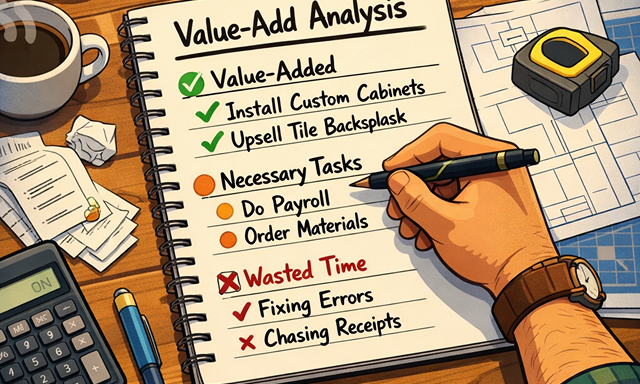
Value-Add Analysis is a simple way to look at how you spend your time and identify which activities actually increase what a customer is willing to pay for your work. When you do this, most tasks fall into one of three categories:
- Value-added activities: Tasks the client is willing to pay for or that directly increase your profit (e.g., installing a marble countertop, upselling a premium tile backsplash)
- Non-value-added but necessary: Tasks that don’t directly increase revenue but are required to run the business (e.g., bookkeeping, writing checks to subcontractors)
- Waste: Tasks that consume time and money without adding value (e.g., fixing data entry errors, tracking Home Depot receipts to finish a cost-plus contract)
4 Steps to increase your construction company’s profitability
1. Audit your time
Start by listing everything you do in a typical week or month. Be as detailed as possible, calls, emails, meetings, site visits, and paperwork all count. It may help to keep a simple journal or notes for a few days instead of relying on memory.
Once everything is listed, categorize each task into one of the three groups above. Don’t worry about being perfect in this categorization; it is more important to get through it and get an idea for where and how you are spending your time.
2. Focus on activities that grow construction profitability
Your goal is to spend most of your time and effort on work that maximizes your results. This may involve working with clients, installing custom cabinets, or overseeing complex parts of a build. Review the value-add activities and identify ways to increase the time and energy devoted to them.
3. Improve processes for necessary tasks
Work that isn’t strictly value-add isn’t any less important; it just might not be what drives direct results for the business. You can not have a functional business without “non-value-added” activities. It might even be a crime to ignore things on this list, like paying taxes.
This is the work that needs to get done, but hopefully doesn’t take up too much of your time. Your goal should be to improve how you approach these tasks. For many contractors, these include creating estimates for bids, managing invoices, doing job costing, and entering data into QuickBooks. All of these tasks take time and need to be done, but they are not the work your customers are paying you to do.
4. Reducing waste with construction automation
You will never eliminate waste or “Non-Value-Add” tasks; this is a fact of life. There will be mistakes and things that just have to get done for unforeseen reasons. The best thing you can do for your business is to set up tools and processes that minimize this waste.
For example, a common problem GCs have is keeping track of expenses spread across multiple projects and locations. Rather than relying on workers to keep meticulous records or turn in paper receipts. A GC can use the Beam Card to automate receipt tracking and organization. By identifying and implementing these solutions, contractors can reduce wasted effort and improve the company’s operations.
Strategy for construction business growth
Whether you’re a one-person remodeling operation or a growing trade business, your most valuable asset isn’t your truck, tools, or equipment; it’s your time.
Contractors who grow sustainably understand this. They focus their energy on the work that drives revenue, put clear guardrails around necessary admin, and use systems to reduce wasted effort. Today’s AI construction tools make this easier than ever, from using AI estimating software to generating realistic construction schedules, or automatically tracking job costs.
If you want to improve profitability without giving up nights and weekends, start by asking one simple question about everything you do:
Is this adding value, or just adding work?
That clarity can reshape how you spend your time, how a growing construction business operates, and ultimately how it grows.
